Tour Itinerary
Day 1: Kilema Gate (1950m) To Horombo Hut (3705m)
Distance: Approximately 16 km
Habitat: Montane forest
Distance: Approximately 7 km
Habitat: Moorland
Meet your guide and embark on your transfer to the Marangu gate, which takes about 45 minutes. The journey passes through the village of Marangu, which is located on the lower slopes of the mountain. Once you reach the park gate, all hikers are required to register at the Park office. After signing in and registering at the Marangu gate, we drive to the Kilema gate.
Upon arrival, you will ensure that you have all your daypack items (containing at least drinking water, your lunch pack, and extra clothing) and do a final check on your mountain bike. You will then start the first route section of 16km, (with your guide also on a mountain bike) from the Kilema gate (1 950m) to the Horombo hut (3 705m) on a 4×4 track. Bikers with good fitness levels, mountain biking skills, and subject to road conditions, will be able to cycle to Horombo hut.
It is important to remember that the biggest cause of altitude sickness is ascending too high too quickly. We will be stopping regularly to give your body the maximum time to adjust to the higher altitudes. We will aim to reach Horombo hut at around 15:00.
We will stop at Horombo Hut for a short break, before commencing on a downhill cycle to Kilema camp. Descending approximately 800m over 7km, the track has a lot of loose rocks and it is important to control your speed and avoid unnecessary risks!
Upon arrival, your porters will have your tent set up at camp and in the evening bring a small bowl of washing water to your tent. The cook will prepare dinner before you retire to your tent for the night. Night temperatures can already drop to freezing point at this camp.
Day 2: Kilema Camp (2950m) To Horombo Hut (3705m)
Distance: Approximately 7 km
Habitat: Moorland
After breakfast, make sure your duffel bag is packed and we cycle from the Kilema camp to the Horombo hut. The trail is steep and has a lot of loose rocks in certain areas. Horombo hut is a village of huts perched on a small plateau, with a total capacity of 120 climbers! Normally bustling with hikers, guides, porters and with an atmosphere of adventure and excitement. You will meet both ascending and descending hikers here.
We arrive in time for a late lunch at Horombo hut. After lunch collect our bikes and go for a 1.5-hour acclimatization cycle up to Zebra Rocks (4 040m) and back.
Enjoy dinner and overnight at Horombo hut.
Day 3: Acclimatization Day to Cycle High & Sleep Low. Horombo Hut (3705m) To Kibo Hut (4730m) To Horombo Hut (3705m)
Distance: 9.6 km up and 9.6km down
Habitat: Alpine desert
After an early breakfast, meet your guide and start your ascent into the Alpine desert habitat. The first 3 km of the trail is very rocky and cycling will be very difficult as this section is very stony and eroded. You will be forced to push and carry your bike for some sections, but after about 3km the trail improves and cycling will once again be possible.
The “Saddle” (which refers to the area located between the peaks of Mawenzi and Kibo) is relatively flat and cycling is much easier. However high altitudes, low oxygen levels, and cold conditions make the 7km section towards Kibo hut strenuous and challenging.
The final km before reaching Kibo hut is especially strenuous. You will once again be reminded to slow down and drink enough water! Upon arrival at Kibo hut lunch will be served.
After lunch, we will embark on an awesome Kilimanjaro Mtb downhill, descending nearly 800m over 7km. The final 3km descent down to Horombo hut is very technical and challenging.
Dinner and overnight at Horombo hut.
Day 4: Horombo Hut (3705m) To Kibo Hut (4730m)
Distance: Approximately 9.6 km
Habitat: Alpine desert
Early wake up and make sure your duffel bags are packed and ready to go. After breakfast, meet your guide and we head back up to Kibo hut. Again the first 3km would require you to push and carry your bike a lot, with the final 7km to Kibo hut offering a good biking trail.
We will enjoy lunch and then aim to rest. At around 16h00 depending on how you feel it is possible to hike partially up the summit path to orientate yourself for the summit attempt later that night.
Situated in the barren Alpine desert is Kibo hut, a stone-built block house that has bunk beds for 60 climbers, but no streams with water nearby. There are platform toilets behind the hut.
The summit (Uhuru Peak) is now a further 1195m up and you will make your final ascent the same night. Prepare your equipment, thermal clothing etc for your summit bid. This should include the replacement of your headlamp and camera batteries and make sure you have a spare set available as well. To prevent freezing it will be wise to carry your water in a thermal flask.
Go to bed at around 19h00 and try to get as much rest and sleep as possible, until 22h00
Day 5: The Summit Night
KIBO HUT (4730M) TO UHURU PEAK (5895M) TO KIBO HUT (4730M)
Cycling time: 7 to 8 hours to reach Uhuru Peak, 3 to 4 hours to descend to Kibo hut,
Distance: Approximately 5.4km ascent and 31 km descent
You will rise around 22h00, and after some tea and biscuits you shuffle off into the night, and this is where the going gets tough. The first section of the trail consists of a rocky path to the Hans Meyer Cave (5150m), also a good resting spot. The path then zigzags up to Gillman’s point (5 681m), which is located on the crater rim. The section just before Gillman’s point known as “Jamaica rocks” is very steep with a lot of stone scree, and boulders requiring a great physical and mental effort.
From Horombo hut up to Gillmans point the trail cannot be cycled and you will have to push your bike up to Jamaica rocks, however from Jamaica Rocks to Gillman’s point, you will have to carry your bike (or if you are not up to it – arrange for a porter to carry your bike). With oxygen levels close to 9.5%, this is probably the most demanding section of the entire route.
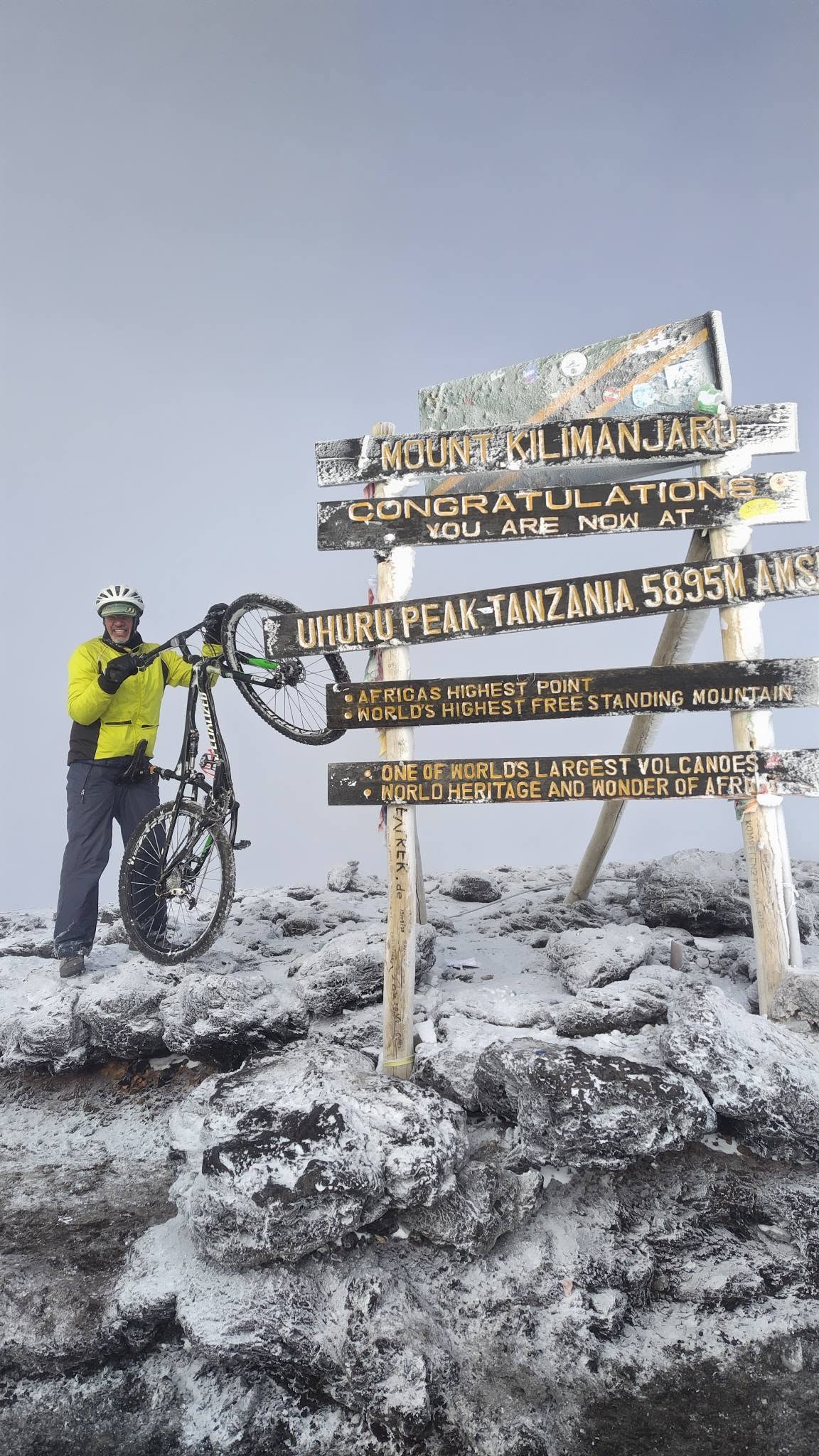
From Gillman’s Point, the trail can be cycled again and you will normally encounter snow up to Uhuru Peak (5895m), the highest point in Africa. Depending on snowfall, mountain bikers with high fitness levels and expert technical mountain biking skills will be able to cycle most of the trail from Gillman’s Point to Uhuru Peak.
Upon arrival at Kibo Hut enjoy a late breakfast and then pack your gear in your duffel bag for the porter to carry down.
KIBO HUT (4730M) – KILEMA GATE (1950M)
Distance: 25KM
You will then embark on the world’s ultimate downhill mountain bike roller coaster ride:
Starting at Kibo hut at 4730m you will descend to the Kilema gate at 1950m distance approximately 31km, descend approximately 3000m in only 3 hours!
NOTE:
The price per person for group expeditions are fixed based on a group size. However, we have optional arrangements for individual private and tailor-made preferences best suited for you, your family and friends.
All prices are based on shared accommodation.
Please inquire for a 1 guest private room accommodation quote